Lofa: memories that rot when you touch them
Every time you touch one of these pieces it rots a little more. A line of poetry appears under your finger, then burns into the image and decays with it.
Lofa is a collection of 4 interactive HTML artworks about what happens to memories when we keep them as files. Each one starts from footage of something I can’t go back to. All 4 pieces of the Origins era are now minted as 1/1s on Ethereum with Transient Labs.
View Lofa on Transient (opens in a new tab)Read the article on X (opens in a new tab)
- Year
- 2026
- Medium
- Interactive HTML, 5 to 14 MB each
- Edition
- 4 × 1/1, Origins era
- Chain
- Ethereum, with Transient Labs
The pieces
Each piece is titled with a line from its own public domain, archival poetry. That line appears on the first stroke and comes back more often than the others.
I have been here before
Self-portrait footage I filmed in the house I sold.
“I have been here before, / But when or how I cannot tell”
from Sudden Light by D. G. Rossetti, 1863
Live piece Drag across it with your mouse. Tap to load it, then hold a finger still for a moment and draw. Open it full screen (opens in a new tab)
Rememberable things
An old coaster shaped like an orange with a small smiley face. It greeted me in my studio every morning for a couple of years and I misplaced it while moving home.
“Rememberable things; sometimes, ’tis true, / By chance collisions and quaint accidents”
from The Prelude by Wordsworth, 1805
Live piece Drag across it with your mouse. Tap to load it, then hold a finger still for a moment and draw. Open it full screen (opens in a new tab)
Things which I have seen
My screen playing one of my earliest AI video experiments, made with Runway Gen-2 in 2023. The image I used in the prompt is broken now so the video can’t be made again.
“The things which I have seen I now can see no more”
from Ode: Intimations of Immortality by Wordsworth, 1807
Live piece Drag across it with your mouse. Tap to load it, then hold a finger still for a moment and draw. Open it full screen (opens in a new tab)
Invisible corruption
A salt lamp in my old studio. Through the camera its glow began to pulse and fold in on itself like a portal. The lamp is gone now and so is the room.
“Invisible Corruption waits to trace”
from Adonais by Shelley, 1821
Live piece Drag across it with your mouse. Tap to load it, then hold a finger still for a moment and draw. Open it full screen (opens in a new tab)
Lofa means rotten
Lofa is Irish for rotten. It’s the word for food gone off and for a system that’s corrupt. Read it in English and it sounds like lo-fi. I wanted all of those at once.
We keep our memories as files now. Phones and cloud storage promise a perfect copy of the day, the room, the face. The copy stays sharp while the memory around it moves. Memory is mutable.
It was never a file. In 2000 Nader, Schafe and LeDoux showed in rats that a fear memory became unstable again when it was recalled.1 It had to be stored again to survive. If that was blocked the memory was lost. Neuroscientists call this reconsolidation. Recalling something is closer to rebuilding it than replaying it.
Files rot too. Formats die, links break and compression throws detail away every time something is saved again. One piece in this collection exists because the image behind an early AI video I made is broken and the video can’t be made again.
Lofa sits in that gap. The footage is corrupt from the moment it’s recorded. Then it rots on screen, repairs itself in patches and rots again, filling its gaps with motion borrowed from elsewhere in the frame.
Touching a piece is recalling it. Your hand drags the picture and a line of poetry about memory appears. Then it sinks into the image and decays with everything else. The file the token points to stays the same. What it shows is never the same twice. What does it mean to put a mutable experience on an immutable blockchain?
How it’s made
Every Lofa piece goes through the same steps, from the camera to the code.
- 01CaptureThe footage is shot on a circuit-bent camera made by Dawnia Darkstone. Its altered circuits corrupt the file as it records. The pulsing glow in Invisible corruption is the camera’s own anomaly.
- 02RecolourI recolour each video in a tool I built with Claude, setting the colours for each one to match the palette I use in my illustration work.
- 03Lose the keyframeTo save space, a video file only stores a full picture every so often. The frames in between just record how parts of that picture move. Datamoshing removes the full pictures so the movement keeps acting on the wrong one. Bit Rot, the engine I designed for Lofa, rebuilds that process in code. It corrupts the first frame before anyone sees it, so the clean footage never shows.
- 04Keep movingEach corrupted block keeps moving its pixels with no new keyframe to correct it. The movement comes from the video’s own motion, a seeded flow field, a pull along edges, a downward melt and rows that close on each other like a jaw.
- 05Rot and repairAfter the first decay the piece keeps going. It rots for 4 to 10 seconds, then repairs patches back towards the playing footage for 2 to 6 seconds on a rhythm set by its seed that never repeats.
- 06TouchDrag with a mouse or, on a touch screen, hold a finger still for a moment and then draw. The blocks under your hand move with you and a slice of the image travels along your stroke.
- 07TextEach stroke carries a line of poetry. When you let go it holds for 3 to 10 seconds depending on its length (just long enough for most people to read it), then burns into the pixels and rots with the picture. Each piece holds 40 lines from poets published between 1595 and 1915. All are public domain and each was checked word for word against its source.
Claude by Anthropic wrote the code to my design and direction and helped check the poem sources. The footage, colour, poem choices and creative decisions are mine. No AI model generates any image or text in the pieces. The one AI-made source is the 2023 video filmed off my screen in Things which I have seen.
The file stays, the story grows
Lofa lives on Ethereum in my own ERC-721TL contract, made with Transient Labs.
Each piece is one self-contained HTML file of 5 to 14 MB with the footage, engine, poems and typeface inside. It makes no network calls and needs no server, so it runs offline and doesn’t depend on any website staying up.
Transient Labs’ Story Inscriptions let the artist and collectors write onto a token after it’s minted. Once a story is added it can’t be changed and it doesn’t alter the artwork. I’ve used them to record the 40 poems in each piece with their poets and years, so the text’s history travels with the work.
They also leave room for collectors. You can inscribe what a piece reminds you of, where it was shown or what changed while you owned it. The image keeps rotting and the written record keeps growing beside it. That’s how memory works too: the picture degrades and the story we tell about it gets longer.
If I ever need to update a piece’s file after it’s collected, Transient’s Synergy feature means the collector has to approve the change first. A memory held by someone else can only be rewritten with their consent.
Where Lofa sits
Lofa belongs to a 60-year line of artists who treat the failure of a medium as its subject.
In 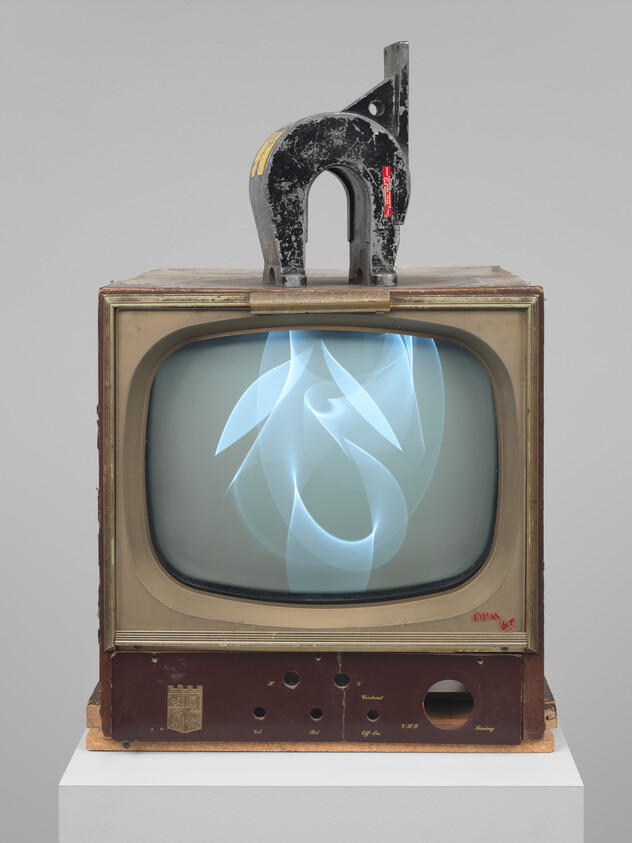 Magnet TV (opens in a new tab)2 (1965) Nam June Paik set an industrial magnet on a television so the broadcast bent around it. Lofa puts the viewer’s hand in the magnet’s place.
Gustav Metzger launched auto-destructive art in 1959, art whose making continues as it falls apart. In I Am Sitting in a Room (opens in a new tab)3 (1969) Alvin Lucier re-recorded his own voice until the room’s resonance dissolved the words. Lofa’s poems take the same path: readable for a few seconds, then worn away.
In 2001 William Basinski tried to digitise tape loops from 1982 and the tape crumbled as it played. The Disintegration Loops (opens in a new tab)4 are the record of that loss. Lofa starts from the same act of turning a memory into a file and makes the loss the material.
Takeshi Murata’s 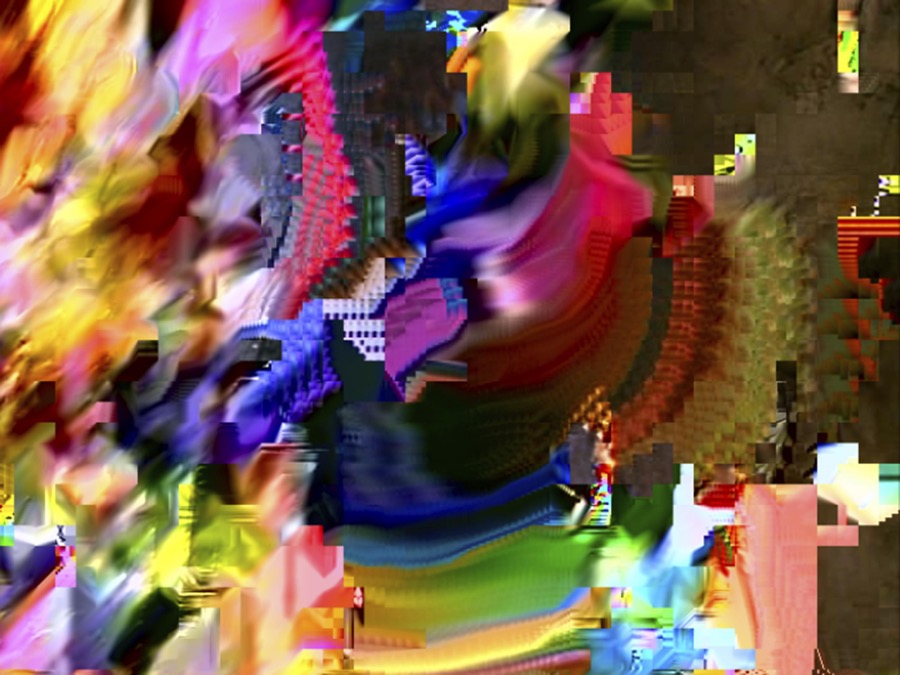 Monster Movie (opens in a new tab)5 (2005) melted the compression of a B movie into pulsing colour. Lofa uses the same codec logic as a live system. There is no finished video to watch, only an engine that keeps moshing for as long as the screen is on.
Hito Steyerl’s In Defense of the Poor Image (opens in a new tab)6 (2009) argued for the value of compressed, degraded copies. Rosa Menkman’s The Glitch Moment(um) (opens in a new tab)7 (2011) treats glitch as something between an artifact and a process. Lofa holds both: a fixed file that only ever shows a process.
What Lofa adds is a memory frame and an owner. The file is fixed forever, the image is never the same twice and the written record grows through Story Inscriptions.
Showing Lofa
Most digital art in a gallery is a video on a wall. It plays the same whether 1 person is in the room or 50. Lofa is built for touch screens, where each visitor recalls the piece with their hand.
- It’s never idle. With nobody touching it the piece keeps rotting and repairing on its own rhythm.
- It fits the space. Each piece fills whatever screen it’s on, whether it’s hung on a wall, standing as a totem or set into a table.
- It works as a set. The 4 pieces run on their own rhythms, so 4 screens side by side never fall into step.
- It’s quiet and offline. No sound, no internet connection and no account are needed during a show.
For a show I can make an exhibition edition for that venue alone. It runs on a new seed used only there. Visitors’ marks are kept and come back as faint scars for the people after them. The piece also ages over the run, so on closing day it’s visibly further gone than on opening day. No 2 venues would show the same work. For screens nobody can touch, a display mode lets a stand-in visitor draw, timed from recordings of my own hand.
A full technical rider is ready. Email me and I’ll send it to you.
Collecting one means holding a memory that keeps changing while its file stays the same.
You get the 1/1 token, the file to run on any screen and a place to add your own stories to its record. These are the only 4 that will ever be minted in the Origins era. Any future pieces will belong to a different era in their attributes.
Credits & sources
- Footage, colour, poem selection and directionAoife O’Dwyer
- CameraDawnia Darkstone (opens in a new tab)
- CodeWritten with Claude by Anthropic
- TypefacePoems set in VT323 by Peter Hull
- Contract and Story InscriptionsTransient Labs (opens in a new tab)
Sources
- 1Nader, Schafe and LeDoux, “Fear memories require protein synthesis in the amygdala for reconsolidation after retrieval” (opens in a new tab) Nature, 2000
- 2Nam June Paik, ‘Magnet TV’, 1965 (opens in a new tab) Modified black-and-white television set and magnet. Whitney Museum of American Art, New York; purchase, with funds from Dieter Rosenkranz 86.60. © Nam June Paik Estate
- 3Alvin Lucier, ‘I Am Sitting in a Room’, 1969 (opens in a new tab) Collection record at The Museum of Modern Art, New York
- 4William Basinski, ‘The Disintegration Loops’ (opens in a new tab) Tape loops from 1982, digitised in 2001
- 5Takeshi Murata, ‘Monster Movie’ (still), 2005 (opens in a new tab) Single-channel video, color, sound; 4:19 minutes. Smithsonian American Art Museum, Museum purchase through the Luisita L. and Franz H. Denghausen Endowment, 2013.71. © 2005, Takeshi Murata
- 6Hito Steyerl, ‘In Defense of the Poor Image’, 2009 (opens in a new tab) e-flux Journal, issue 10
- 7Rosa Menkman, ‘The Glitch Moment(um)’, 2011 (opens in a new tab) Institute of Network Cultures
View Lofa on Transient (opens in a new tab)Read the article on X (opens in a new tab)